The Survival Pivot: Why Djarum Became a Filtered Cigar
In the autumn of 2009, American clove enthusiasts faced an existential crisis. The Djarum Black, a product that had dominated the specialty tobacco landscape for decades, was suddenly illegal to sell as a cigarette. This was not a result of a change in consumer taste or a decline in brand popularity, but a massive federal intervention known as the Family Smoking Prevention and Tobacco Control Act. To the casual smoker, the product on the shelves today—the "Djarum Black Clove Cigar"—looks nearly identical to its predecessor. However, beneath the familiar black aesthetic lies a total engineering overhaul mandated by federal law. Why did Djarum make this transition, and how does the shift from paper to tobacco leaf fundamentally alter the physics of the smoke? To understand why Djarum became a cigar is to understand the tactical survival of an Indonesian legend in an increasingly adversarial American market.
The September 22 Mandate: The Ban on Flavored Cigarettes
The primary catalyst for the transition was Section 907(a)(1)(A) of the 2009 Tobacco Control Act. This federal statute explicitly prohibited the sale of "cigarettes" containing a characterizing flavor other than tobacco or menthol. Because Djarum Black was primarily identified by its intensive clove flavor, it was a primary target for the ban. The government's goal was to reduce youth initiation by removing sweet and spicy products from the market. However, the law contained a critical technicality: the ban applied strictly to cigarettes. By redefining the vessel of the smoke, Djarum found a way to remain on retail shelves while complying with the letter of the law, an event tied closely to the history of the 2009 clove cigarette ban.
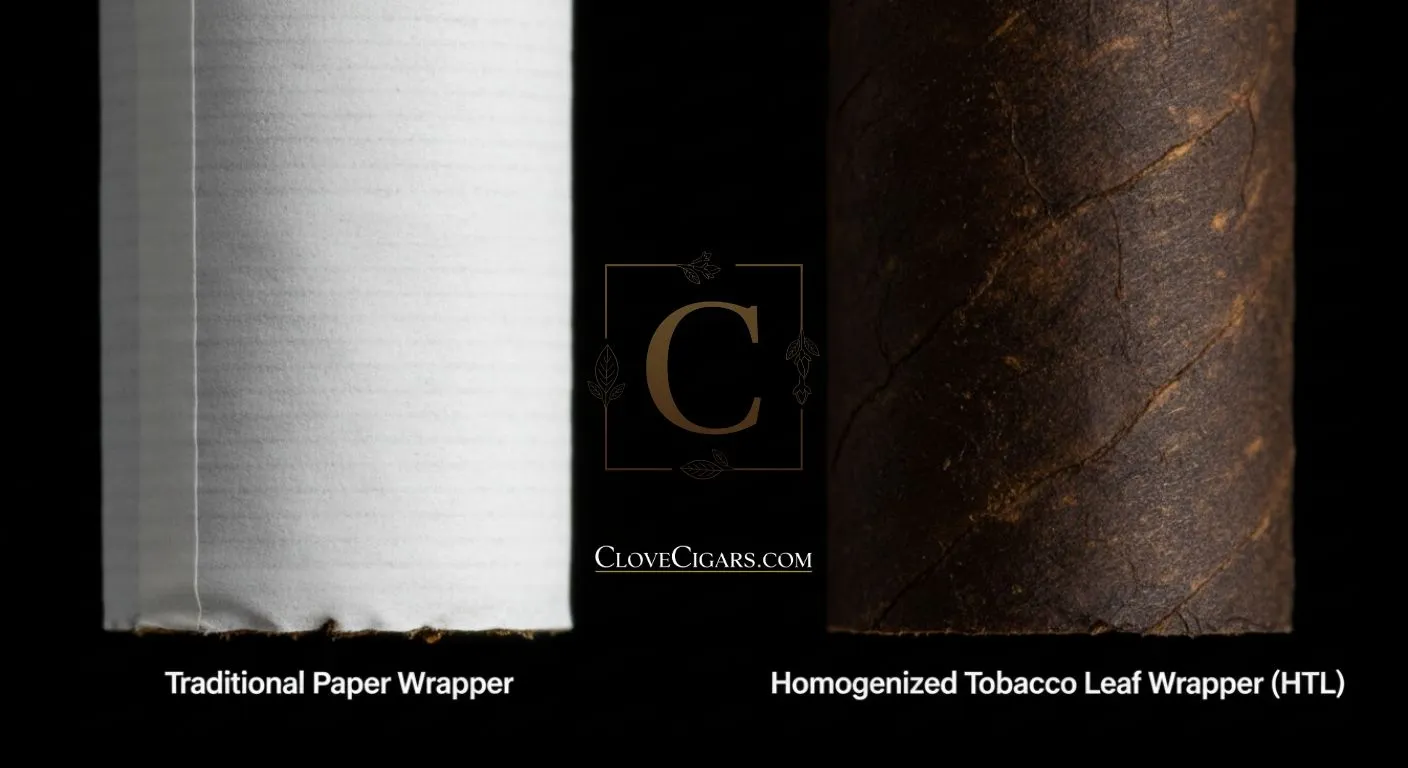
Technical Re-Engineering: The Homogenized Tobacco Leaf (HTL)
To qualify as a cigar under the Internal Revenue Code, a tobacco product must be wrapped in leaf tobacco or a substance containing tobacco. Djarum achieved this by adopting Homogenized Tobacco Leaf (HTL), a material made from tobacco pulp and binders. Unlike the neutral white or black paper used in the past, HTL is a tobacco-based product. Furthermore, legal cigars must meet specific weight and construction standards to avoid being classified as "cigarettes" by the FDA. This technical pivot was not without consequences; HTL is thicker and burns at a different temperature than paper, which introduces an earthier, heavier base note to the flavor profile. This is the primary reason why many users report that the modern Djarum Black clove cigar review feels "stronger" or "denser" than the 1990s cigarette version.
The Eugenol Factor: Masking the Harsher Cigar Profile
The move to a tobacco-leaf wrapper theoretically makes for a harsher smoking experience, as cigar smoke is chemically more aggressive and higher in particulate matter than cigarette smoke. However, Djarum’s secret weapon remains the clove itself. Cloves contain up to 90% eugenol, a natural anesthetic. When the clove oil flash-boils during the "kretek" burn, it releases vaporized eugenol that numbs the throat. This pharmacological interaction masks the heaviness of the cigar smoke, allowing the user to experience the signature smoothness of the Djarum brand despite the more robust tobacco wrapper. This "smoothness paradox" is what has allowed the cigar version to maintain the loyalty of the original cigarette consumer base. Enthusiasts who want to experience the unadulterated Indonesian blend can still buy original Djarum products through international channels, though these remain subject to strict US Customs regulations.
Analysis & Insight: The 2026 Regulatory Convergence
While the cigar reclassification saved the brand in 2009, the 2026 regulatory landscape is closing the loop. New state-level laws, particularly in California, are moving beyond category distinctions to ban all flavored tobacco products regardless of their wrapper. California's Unflavored Tobacco List (UTL) effectively marks the end of the "cigar loophole" in the country’s largest market. In this environment, Djarum has pivoted once again, introducing tobacco-free alternatives like Djarum Bliss. This latest evolution preserves the "soul" of the product—the Indonesian spice "sauce"—without the tobacco leaf that triggers the California flavored tobacco law. For the collector and connoisseur, understanding these shifts is essential for navigating the twilight of the tobacco-based kretek.
Conclusion
Djarum became a cigar because the alternative was extinction. By embracing common-sense engineering—moving from paper to HTL and increasing product weight—the brand successfully outmaneuvered a federal ban that would have otherwise erased it from the American market. While the 2009 transition permanently altered the sensory profile of the Djarum Black, introducing a more robust, earthy character, the inclusion of eugenol ensures that the "soul" of the experience remains unchanged. As we enter the 2026 era of total flavor prohibition and retail whitelists, the story of why Djarum became a cigar serves as a testament to the resilience of Indonesian craftsmanship and the enduring power of the clove scent. Whether you choose the filtered cigar or the modern herbal Bliss, you are participating in a tradition of survival that has spanned nearly 150 years.